










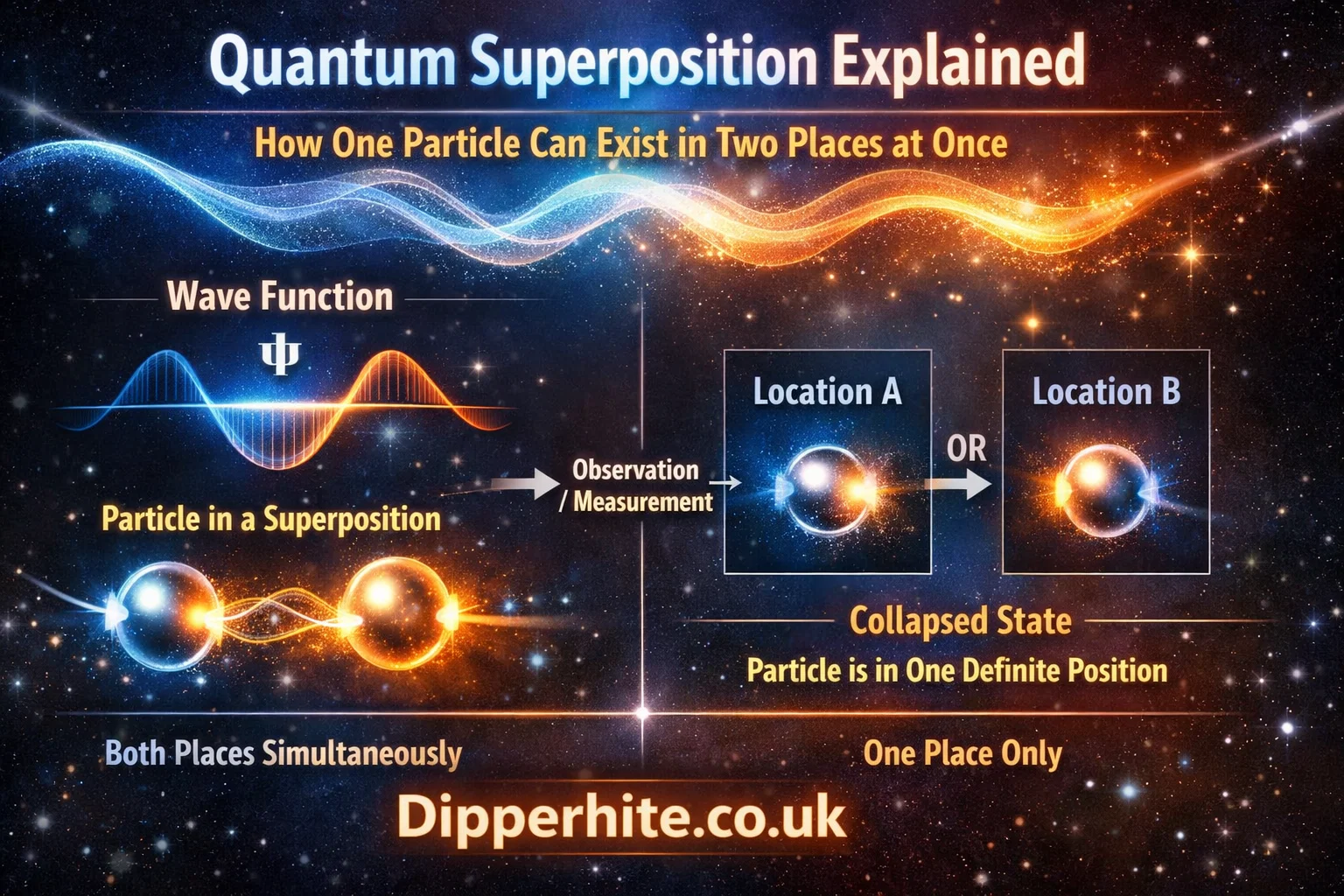
Quantum Superposition Explained: How One Particle Can Exist in Two Places at Once
Quantum superposition is one of the most fascinating and mind-bending concepts in modern physics. At first glance, it seems to defy logic: a particle can exist in multiple states at once until it is observed. This idea challenges our everyday understanding of reality and opens the door to groundbreaking technologies.
In this comprehensive guide, we explore what quantum superposition is, how it works, and why it plays a central role in quantum mechanics and emerging innovations. Whether you’re a curious reader or a serious learner, this article provides a clear, expert-level explanation.
What is quantum superposition
Quantum superposition refers to the ability of a quantum system, such as an electron or photon, to exist in multiple possible states simultaneously. Instead of being in one definite state, it exists in a combination of all possible states until measured.
This principle is foundational to quantum mechanics. Unlike classical objects, which always have fixed properties, quantum systems described by quantum superposition behave probabilistically rather than deterministically.
How quantum superposition works
At the heart of quantum superposition lies the wave function, a mathematical description of all possible states of a particle. These states combine into a superposition, representing probabilities rather than certainties.
When a measurement occurs, the wave function collapses into a single outcome. This “collapse” is one of the most mysterious aspects of quantum superposition and continues to be a topic of scientific debate.
Schrödinger’s cat explained
The famous thought experiment of Schrödinger’s cat illustrates quantum superposition in a more intuitive way. A cat is placed in a box with a quantum-triggered mechanism that has a 50% chance of killing it.
Until the box is opened, the cat is considered both alive and dead in terms of quantum superposition. While purely hypothetical, this example highlights how strange quantum behavior appears when applied to everyday objects.
Classical physics vs quantum superposition
In classical physics, objects have clearly defined properties at all times. A car has a precise location, speed, and state, with no ambiguity involved.
Quantum superposition, however, introduces uncertainty. Particles do not have definite properties until observed, making the quantum world fundamentally different from classical expectations.
Real-world applications of quantum superposition
Quantum superposition is not just theoretical—it underpins powerful technologies. Quantum computers, for example, use qubits that can exist in multiple states simultaneously, allowing massive parallel computation.
It also plays a key role in quantum cryptography, where security is based on physical laws rather than algorithms. This creates communication systems that are extremely difficult to compromise.
Quantum superposition in computing
Traditional computers use bits that are either 0 or 1. In contrast, qubits leverage quantum superposition to represent both states at once, greatly increasing computational power.
This enables solutions to complex problems such as molecular modeling, optimization, and advanced AI calculations that would take classical systems impractically long to solve.
Comparison table: classical vs quantum systems
| Feature | Classical Physics | Quantum Superposition |
|---|---|---|
| System state | Definite | Multiple simultaneous states |
| Measurement effect | No change | Collapses superposition |
| Predictability | Deterministic | Probabilistic |
| Scale | Macroscopic | Subatomic |
| Example | Moving vehicle | Electron in many positions |
Interpretations of quantum superposition
Different interpretations attempt to explain quantum superposition. The Copenhagen interpretation suggests that reality does not exist in a definite state until observed.
Meanwhile, the many-worlds interpretation proposes that all possible outcomes occur in separate parallel universes. Both frameworks aim to explain the same phenomenon from different philosophical perspectives.
Importance in modern science
Quantum superposition is essential for understanding fundamental physical processes. It explains phenomena like interference and quantum entanglement.
Beyond theory, it drives innovation in fields such as medicine, materials science, and cybersecurity. Its influence continues to grow as research advances.
Challenges and limitations
Despite its promise, maintaining quantum superposition is extremely difficult. Quantum systems are highly sensitive to environmental interference, leading to decoherence.
This instability remains a major obstacle in building scalable quantum technologies. However, ongoing research is steadily overcoming these barriers.
Common misconceptions
A common misunderstanding is that quantum superposition allows large objects to literally exist in multiple places at once. In practice, this behavior is nearly impossible to observe at macroscopic scales.
Another misconception is that human consciousness is required for observation. In reality, any interaction that measures the system can collapse quantum superposition.
Read More: USA vs Iran News Just Took a Shocking Turn — What Happens Next Will Surprise You
Expert quote
“If you think you understand quantum mechanics, you don’t understand quantum mechanics.” — Richard Feynman
This quote captures the deep complexity and counterintuitive nature of quantum superposition, even for experts in the field.
The future of quantum superposition
The future of quantum superposition is closely tied to advances in quantum technology. As scientists improve control over quantum systems, practical applications will expand rapidly.
From ultra-secure communication networks to powerful simulation tools, quantum superposition will continue to shape the next era of technological innovation.
Conclusion
Quantum superposition is more than a theoretical concept—it is a gateway to a deeper understanding of reality. By challenging classical assumptions, it reveals a universe governed by probabilities and possibilities.
As research progresses, its impact will extend far beyond physics, influencing industries and technologies that define the future. Understanding quantum superposition today means staying ahead in a rapidly evolving scientific landscape.
FAQ about quantum superposition
What is quantum superposition in simple terms?
Quantum superposition means a particle can exist in multiple states at the same time until it is measured.
Does quantum superposition apply to large objects?
In theory yes, but in practice quantum superposition is extremely difficult to observe in large systems due to decoherence.
How is quantum superposition used in technology?
Quantum superposition is used in quantum computing, where qubits process information more efficiently than classical bits.
Does quantum superposition break the laws of physics?
No, quantum superposition is a fundamental part of quantum mechanics, even though it contradicts classical intuition.
What happens when a system in quantum superposition is measured?
When measured, quantum superposition collapses into a single observable state.